Service
Finite Element Analysis (FEA)
Understand structural performance before committing to manufacturing.
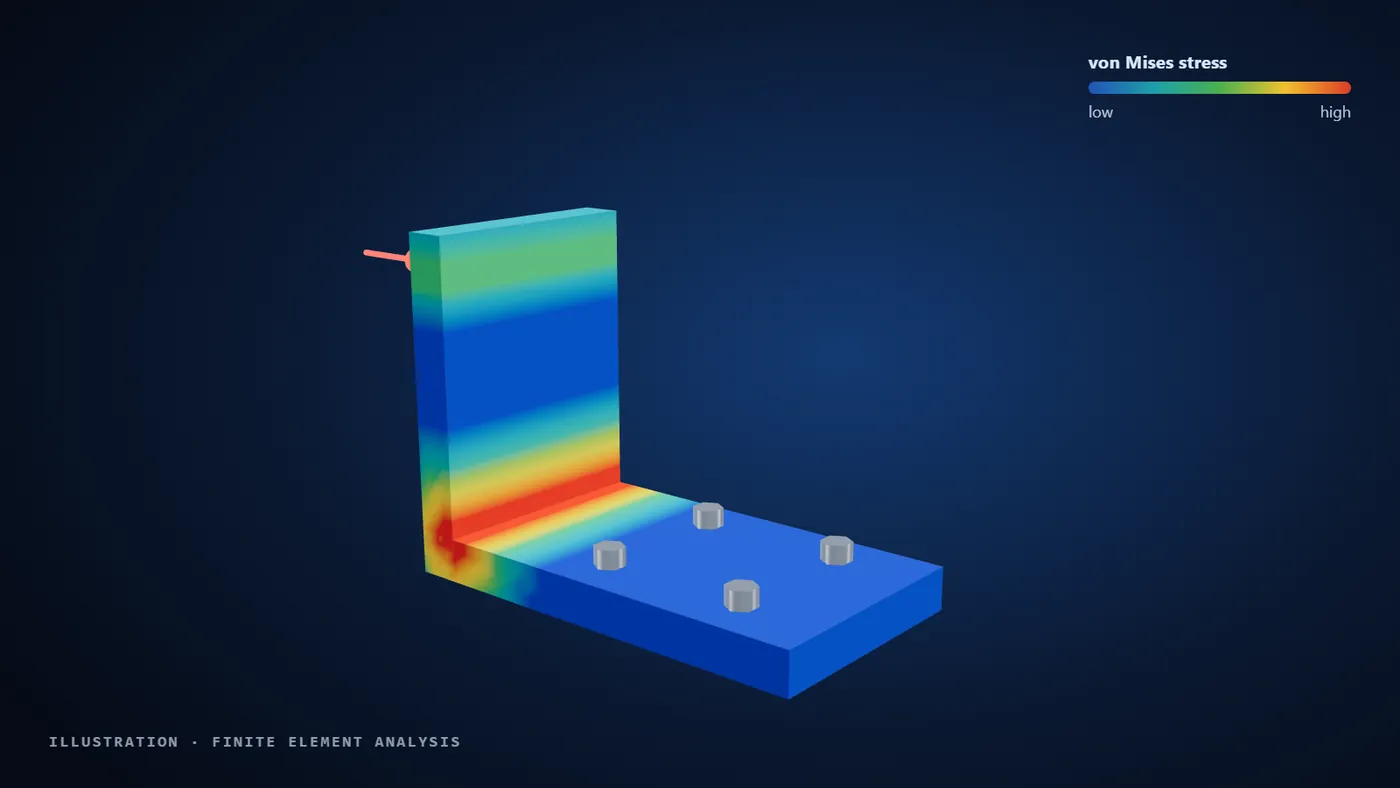
FEA shows how a component or assembly responds to its working loads — where stress concentrates, how much it deforms, and how much margin remains — so design decisions are made before steel is cut.
What we do
- Evaluate stresses, strains, and deformation in components and assemblies
- Identify highly stressed regions and potential structural weaknesses
- Assess component strength under defined loading conditions
- Study load distribution through components, joints, and supporting structures
- Evaluate safety margins against specified material limits
- Investigate design changes to reduce weight or improve structural performance
- Support fatigue or buckling assessments where suitable methods and input data are available
Engineering problems we help solve
- Component deformation under working loads
- Cracking or failure around holes, corners, welds, and mounting points
- Excessive material usage and weight-reduction opportunities
- Insufficient stiffness or structural strength
- Load transfer between connected components
- Performance of brackets, frames, housings, shafts, and machine structures
Our approach
- 01Define the problemUnderstand the component, operating loads, and acceptance criteria.
- 02Build the modelPrepare geometry, mesh, connections, loads, and boundary conditions.
- 03Solve & checkRun the analysis and verify the numerical results.
- 04Interpret & recommendIdentify critical regions and recommend design improvements.
What you receive
- FEA model and mesh information
- Stress, strain, and displacement contour plots
- Reaction forces and load-path interpretation
- Factor-of-safety assessment against defined criteria
- Design improvement recommendations
- Engineering report with assumptions and limitations
Tools & technology
ANSYSAbaqusHyperMeshNastranSolidWorks Simulation
Who it's for
Automotive
Heavy Engineering
Industrial Equipment
Oil & Gas
Frequently asked questions
What do you need from us to start an FEA study?
CAD geometry (or drawings), material details, the loads and supports the part sees in service, and the acceptance criteria you need it to meet.
Can FEA find the cause of a failure that has already happened?
Yes. Matching the analysis to where and how a part failed is one of the most common uses of FEA, and it points directly to the design change needed.
Ready to start?