Service
Dynamic Analysis
Understand how your product behaves when forces, vibration, and operating conditions change over time.
Vibration, impact, and rapidly changing loads cause failures that static checks never see. Dynamic analysis finds resonance risks and the changes that move a structure away from them.
What we do
- Evaluate structural response to time-varying loads
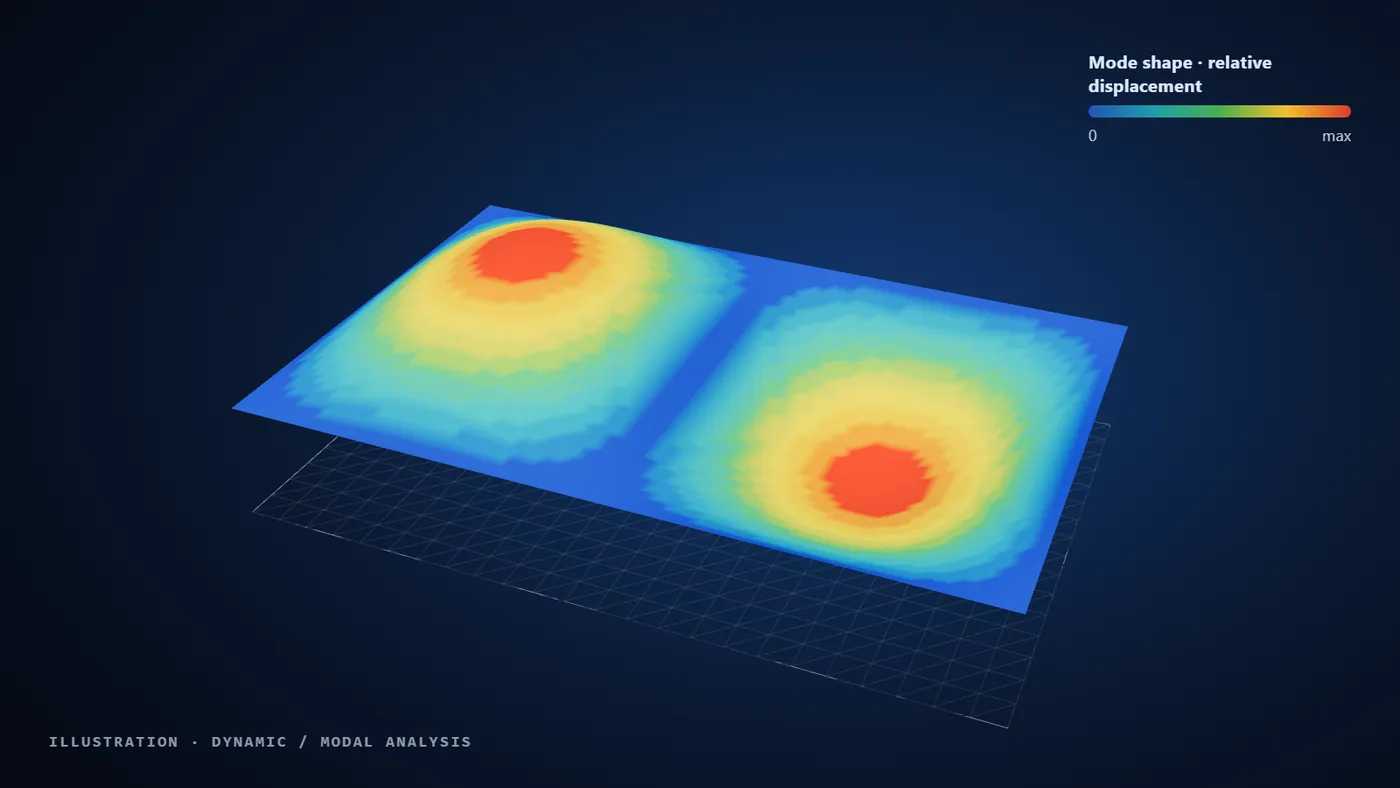
- Identify natural frequencies and mode shapes (modal analysis)
- Assess vibration response under specified excitation
- Study transient loads, impact events, and rapidly changing forces
- Evaluate the influence of mass, stiffness, damping, and supports
- Investigate resonance risks and vibration-reduction measures
- Support fatigue assessments when loading history and fatigue data are available
Engineering problems we help solve
- Excessive vibration in machinery or automotive components
- Resonance near operating or excitation frequencies
- Structural response to sudden or changing loads
- Vibration-related damage or premature fatigue
- Dynamic loads transmitted through supports and mounts
- Excessive movement during acceleration, braking, or transient events
Our approach
- 01ExcitationDefine operating speeds, loads, and excitation sources.
- 02Modal analysisFind natural frequencies and mode shapes.
- 03ResponseCalculate frequency or time response where required.
- 04RecommendPropose stiffness, mass, damping, or support changes.
What you receive
- Natural frequencies and mode shapes
- Frequency-response or time-response results
- Displacement, acceleration, and stress response plots
- Identification of potential resonance conditions
- Recommendations for stiffness, mass, damping, or support modifications
Tools & technology
ANSYSAbaqusNastranNI DAQ (test correlation)
Who it's for
Automotive
Heavy Engineering
Industrial Equipment
Energy & Process
Frequently asked questions
Can you correlate the analysis with measured vibration?
Yes. Where measured data is available, we compare it with the model to confirm the results and find the true source of vibration.
What is modal analysis used for?
It finds the frequencies at which a structure naturally vibrates. Keeping those away from operating speeds avoids resonance.
Ready to start?